What a video coordinator does all day
The least visible job on a basketball staff, and the one most likely to be held by the next head coach. Here is the actual work.
On a basketball staff there is a job with no visible output, no public credit, and a remarkable record of producing head coaches. The video coordinator sits between the raw record of what happened and everything the staff believes about it, and the reason the role is a pipeline to the top job is that it is the only position on a staff that is required to watch everything.
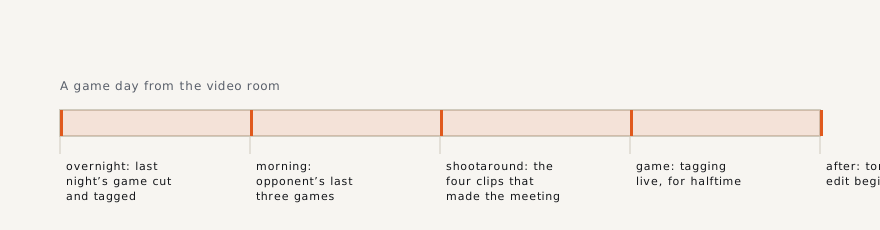
Overnight: last night becomes data
The work begins when a game ends. The game has to be cut and tagged — every possession broken out, labelled by action, by personnel, by outcome — so that it can be queried later. Not summarised; indexed.
The tagging schema is specific to the staff and it encodes the coaching staff's beliefs. A team that cares about how it defends screens will tag every screen by coverage. A team building an offence around a particular action will tag every instance of it and every variation. The schema is, in effect, a written statement of what this staff thinks matters, and the video coordinator both maintains it and is the only person who sees its gaps.
This is overnight work because the staff needs it in the morning, and it is why the job is notorious for its hours.
Morning: the opponent, compressed
Before a game, somebody has to reduce several of the opponent's recent games to something a coaching staff can use in a meeting. That means answering specific questions from assistants — what do they do against this coverage, where does their best shooter get his attempts, what happens after a timeout — each of which is a query against the index and then a human judgement about which four or five clips answer it honestly.
That last part is the real skill and it is a form of editorial work. A query returns thirty clips. A meeting has room for four. Which four get shown determines what the team believes about the opponent, and the person choosing is usually the most junior person in the room.
A video coordinator who selects the most dramatic examples produces a team that is prepared for the opponent's highlights. One who selects the most representative examples produces a team prepared for the opponent. Nobody outside the staff can tell the difference until the game.
Shootaround: four clips
By the time the team meets, the day's work has been compressed to a handful of clips and a few sentences. The coordinator runs the room's playback, which sounds trivial and is not: a meeting lives or dies on whether the right clip comes up immediately when a coach asks for it, and the ability to produce any moment from any recent game on request is what makes the role indispensable in the eyes of the staff.
Game: tagging live, for halftime
During the game the coordinator is working, not watching. Tagging continues in real time so that halftime can be useful — a halftime adjustment is only possible if somebody can produce evidence of the problem within about four minutes of the second quarter ending.
In many staffs there is also a bench-side feed, and the coordinator is the person who can surface a specific previous possession on a tablet while play continues. The latency of that request is the practical limit on how responsive a coaching staff can be.
After: tomorrow begins
The game ends and the cycle restarts, with the additional work of whatever the staff now wants to look at. During a season there is no day on which the video room is caught up.
Why it produces coaches
Three reasons, and they are structural rather than sentimental.
The coordinator watches more basketball than anyone else in the building, including the head coach, and watches it analytically because it has to be labelled.
The job requires understanding what every coach on the staff is trying to find out, which means absorbing several coaching philosophies at once and seeing where each one is strong.
And it is a job in which the quality of judgement is visible to the staff and invisible to everyone else — which means advancement comes from the people best placed to assess it. That is an unusually clean selection mechanism, and it is the reason a surprising number of head coaching careers start in a dark room with a tagging schema.