How a timeout is actually spent
The huddle on television is the last fifteen seconds of it. The useful part happened before the coach arrived.
On television a timeout is fifteen seconds of a coach drawing on a whiteboard in a huddle of players, shot from above, with the commentary speculating about what he is drawing. That is the last fifteen seconds of it, and it is the least important part. The decision being communicated was made before the coach reached the bench.
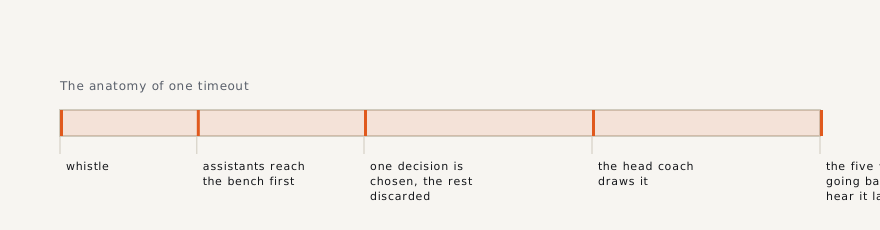
The first seconds belong to the assistants
When the whistle goes, the head coach is typically still on the floor side of the bench, and the players are walking. The assistants are already talking — to each other, not to the players.
That conversation is the actual work of the timeout. One assistant has been tracking what the opponent's defence has been doing on a particular action. Another has a note about a matchup. Someone has the foul situation and the timeout count. In many staffs someone is holding a tablet with two or three clips already queued, pulled live by the video staff.
What emerges from those seconds is not a play. It is a shortlist: here are the two or three things we could do, and here is the one that fits the situation. The head coach's job in a timeout is frequently to choose from that shortlist rather than to generate it, and the quality of a staff is largely the quality of the shortlist it can produce in ten seconds.
Then the discard
A timeout cannot deliver three ideas. It can deliver one, reliably, and a second one imperfectly. So somebody has to throw away the other suggestions, and throwing them away is a skill — a staff that brings every idea into the huddle produces a huddle where nothing was communicated.
This is the part that is invisible from outside and the part that most distinguishes a functioning staff from a dysfunctional one. The discard happens in the second or third sentence of the assistants' conversation, before anybody has spoken to a player.
Then, and only then, the whiteboard
By the time the players are seated the decision exists. What happens in the huddle is transmission, and it is shaped by how little time is left: one instruction, stated in the team's own shorthand, with the floor positions sketched because a drawing is faster than a sentence.
Most of what gets said in a huddle is not tactical at all. It is assignment — who is guarding whom when play resumes, who is inbounding, who is going where — because the thing most likely to go wrong after a stoppage is not the design but the question of which five players are on the floor and what each of them thinks their job is.
The five players who are about to play hear the instruction last, which sounds backwards and is not. They are the only people in the huddle who have to execute it, and the instruction has to reach them as close as possible to the moment they act on it.
Why the opponent is also using the time
A timeout is symmetrical, and that constrains what it can be used for. Anything a coach draws can be anticipated by the staff eight metres away, who have the same clips and the same tendencies. This is why late-game timeouts so often produce something that looks ordinary: the unusual option was discarded precisely because it was the one the opponent would expect.
It also explains the occasional decision not to call a timeout at all. A stoppage lets the defence organise, substitute and set its matchups. A team that has an advantage in a live situation may be better off keeping the ball moving and keeping the opponent's staff out of it, and coaches who decline a timeout in a visibly chaotic moment are usually making that trade.
What a timeout is for, in order of frequency
Stopping an opponent's run, which is about breaking rhythm rather than about tactics. Resetting assignments after a defensive breakdown. Resting specific players at a specific moment in a specific rotation plan. Managing the clock late, which is the only use that is primarily arithmetic. And last, far behind the others, drawing a play that scores — the use that television is built around and that accounts for a small minority of timeouts called.
The next time the overhead camera finds a huddle, watch the assistants in the half-second before the shot cuts. Whatever they have decided is already decided.