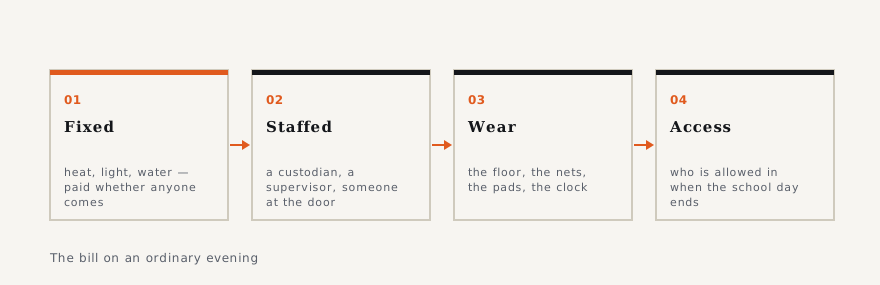
How a school team actually gets its floor time
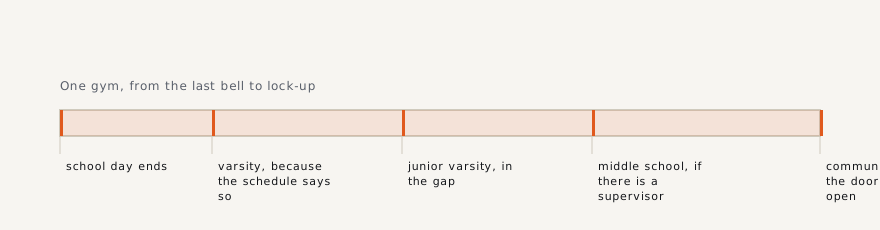
One gym, one afternoon, and more teams than slots. The way that gets resolved explains more about youth basketball than any coaching argument.
One gymnasium. One afternoon between the last bell and lock-up. More teams than there are slots. How that gets resolved explains more about youth basketball — who develops, who drops out, which programmes grow — than any argument about coaching methods, and it is almost never discussed, because it is a scheduling problem and scheduling problems are boring until you are on the wrong end of one.
The shape of the afternoon
The usable window is short. School ends, the building has to be clear by a certain hour, and in between there is a block of a few hours that has to accommodate every team that calls this gym home. In a school with boys' and girls' programmes at varsity, junior varsity and freshman levels, plus a middle-school feeder and whatever community use exists, that is potentially eight or more groups competing for three or four usable slots.
The gym can sometimes be split across its width for practices that do not need a full floor, which doubles capacity at the cost of quality, and split use is the single most common accommodation made.
Who gets the good slot, and why
The good slot is the one immediately after school: players are already in the building, nobody needs a ride home in the dark, and the coaching staff is on contract hours.
That slot goes to varsity, essentially always, and the reason is not favouritism in any simple sense. The varsity schedule is externally fixed — game dates are set by a league, often a season in advance — and everything else in the building has to be arranged around a calendar nobody at the school controls. Game days, travel days and the day before a game all constrain when varsity can practise, and those constraints propagate downward.
Junior varsity takes what is left adjacent to that, usually the second slot, frequently on a half floor. Freshman and middle-school teams get the late slot, the early morning, or the shared half.
The late slot is where players are lost
This is the consequential part. A practice that ends after dark creates a transport problem, and the transport problem does not fall evenly. A player with a car, or a parent with flexible hours, is unaffected. A player who depends on a bus that has stopped running, or on a parent working an evening shift, is not.
So the schedule quietly selects. Over a season, attendance in late slots degrades, and it degrades along lines that have nothing to do with ability or commitment. Coaches of younger teams know this and will often trade a worse facility — a cafeteria, an auxiliary gym, a half floor at an earlier hour — for a time that their players can actually reach. That trade is usually the right one and it is invisible in any discussion of player development.
What the morning slot costs
Some programmes solve the problem by moving to before school. It works, it is used widely, and it has its own selection effect: early practice requires a ride at an hour when public transport may not be running at all, and it costs sleep from adolescents who are already short of it. Programmes that run morning practices tend to be in schools where most families can provide a morning ride.
Community use is last and first to go
Anything that is not a school team — a youth league, a recreational group, an outside club — sits behind every school team in the queue and is the first thing cut when the schedule tightens or when supervision funding fails. This is why access to a public school gym for non-school basketball is so inconsistent between districts: it is the residual, and residuals disappear first.
The lever nobody pulls
Most arguments about youth basketball access are about facilities — build another gym, build a community court. Those are expensive and slow. The cheap lever is the schedule itself: publishing it, rotating the good slot between levels across a season rather than fixing it, and aligning the late slot with whatever transport actually exists.
Rotation in particular costs nothing and is rarely done, because the varsity calendar is the one thing that cannot move and it is easier to let it determine everything else. It does not have to. Most of what a gym schedule decides about who keeps playing is decided by default rather than on purpose.