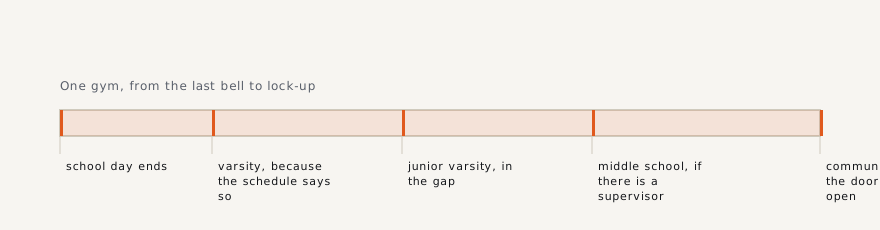
What a high-school gym costs to keep open
Not what it cost to build. What it costs on an ordinary Tuesday in February, line by line, and which of those lines is the one that closes gyms.
Nearly every conversation about a school gymnasium is about what it cost to build. That is the number that appears in a bond measure and in a ribbon-cutting. It is also the number that has almost nothing to do with whether the gym is open on an ordinary Tuesday evening in February. The operating bill is smaller, duller and far more decisive, and it is structured in a way that makes one line item the usual cause of a locked door.
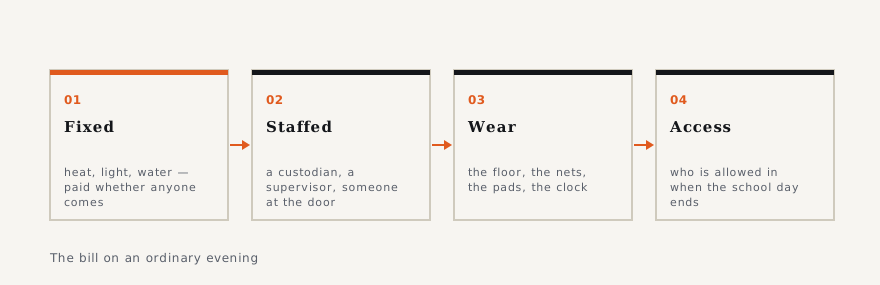
The fixed line: the building does not care whether anyone comes
A gymnasium is a large, high-ceilinged volume that has to be heated in winter, ventilated year-round and lit from above. Those costs are driven by the building's size and the outside temperature, not by how many people are inside. Heating an empty gym costs very nearly what heating a full one costs.
That has an important implication that gets the logic backwards from what people expect: marginal use of a gym is cheap. If the building is already warm and lit for a varsity practice, the next group through the door adds almost nothing to the energy bill. The expensive thing is opening the building at all on a day it would otherwise be closed.
The staffed line: this is the one that closes gyms
A gym that is open requires people. At minimum, somebody has to unlock and lock it, and somebody has to be responsible for what happens inside — a supervisor, which in most jurisdictions is a legal requirement rather than a preference, because an unsupervised minor in a school building is a liability question before it is anything else.
Depending on what is happening there may also be a custodian on overtime, someone at the door, and an athletic trainer. Each of those is an hourly cost that begins when the building opens and ends when it closes, and unlike energy it does not spread across additional users for free — more hours means more hours.
This is the line item that decides availability. A district that cannot fund evening supervision has a gym that closes at the final bell, regardless of how many teams want it and regardless of how cheap the marginal heating would have been. When a community programme loses access to a school gym, the proximate cause is almost always supervision hours rather than utilities.
The wear line: slower, larger than it looks
A wood floor is a consumable. It needs regular screening and recoating, and at long intervals a full sand and refinish, and the interval depends on use. Nets, backboard pads, wall pads, bleacher mechanisms, the scoreboard and the shot clocks all have service lives measured in years, and all of them are safety items as well as equipment, which means deferred maintenance eventually becomes a reason the gym cannot be used at all.
Wear is the least visible part of the bill because it does not arrive monthly. It arrives as a single large number in a year when several things come due at once, and it is the item most often deferred, which is why so many school gyms are simultaneously heavily used and visibly worn.
The access line: not money, and still part of the cost
The last item is not on any invoice. Who is allowed in, and when, is governed by policy: the athletic department's schedule, the district's facility-use rules, insurance requirements for outside groups, and whatever fee schedule applies to community use.
A gym can be heated, staffed and in good repair and still be unavailable because the request came from a group without insurance, or outside the booking window, or from a sport with no standing claim on the schedule. Administrative access is a real cost paid in effort by whoever is trying to get through the door.
Why this matters for anyone arguing about youth sport
Because the usual proposals address the wrong line. Donating equipment addresses wear. Fundraising for a new floor addresses capital. Neither buys a single additional evening of supervised access, which is what a programme actually needs.
The cheapest way to get more basketball played in an existing gym is to pay for supervision hours and to simplify the booking rules. It is unglamorous, it does not come with a plaque, and it is close to the only intervention that reliably opens a door that was closed.