What the shot clock did to the last two minutes of a basketball game
The clock was introduced to stop stalling. Its deepest effect was to turn the end of a close game into a counting problem.
The shot clock was introduced to stop teams from stalling. It solved that problem immediately and completely, and it has been justly credited with saving the sport from unwatchability. Its more interesting effect was downstream and took longer to appear: it turned the end of a close basketball game into an arithmetic exercise, and that exercise is now most of what coaches and players are doing in the last two minutes.
Before: the end of a game was a hiding place
Without a clock on the possession, a team in the lead could simply keep the ball. The losing team's only recourse was to foul, and so the end of a close game became an exchange of deliberate fouls and free throws, with long stretches of nothing happening in between. The leading team's optimal strategy was to stop playing basketball.
After: possession has a price, and the price is known
A shot clock makes every possession finite. That one change converts the endgame from a stalling contest into a budgeting problem, because now both teams know roughly how many possessions remain and can count them.
This is the core of modern endgame management, and it is genuinely arithmetic. A team down by a certain margin with a certain number of possessions remaining has to decide how many points per possession it needs and how much time it can afford to spend getting them. The decisions that follow — whether to take the first available three or run a full action for a better one, whether to foul immediately or let the clock run, whether to use a timeout to advance the ball — are all derived from that count.
The reset is where the subtlety lives
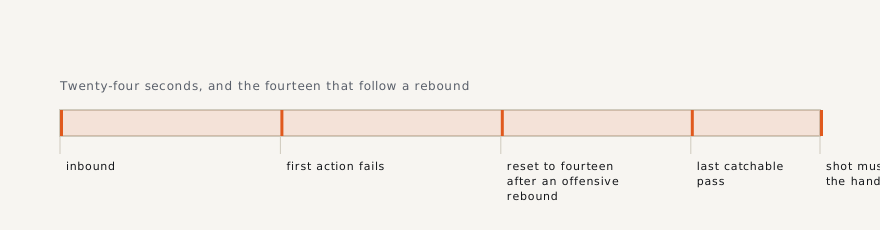
The clock does not simply run from the full allotment every time. An offensive rebound resets it to a shorter period rather than the full one, which is a rule designed to stop a rebounding team from manufacturing fresh full possessions out of its own misses.
That shorter reset is disproportionately important at the end of a game. A team that is leading and rebounds its own miss has bought a chunk of clock without having to score. A team that is trailing and allows an offensive rebound has lost that chunk and has to find it back somewhere. Watch the bench reaction to an offensive rebound in the final minute of a close game: the celebration is about time, not about the extra shot.
Two clocks, running against each other
The thing that makes the endgame hard is that there are two clocks with different interests. The game clock is the trailing team's enemy and the leading team's friend. The shot clock is the opposite: it forces the leading team to shoot, which is the one thing it would rather not do.
So the leading team's job is to make the two clocks line up — to spend as much game clock as possible inside each possession while still producing an attempt before the shot clock expires. Hence the familiar shape of a late possession by a leading team: nothing happens for a long time, then a very fast sequence at the end. That is not passivity. It is an attempt to arrive at the shot clock and the game clock simultaneously.
The trailing team's job is the mirror image: end possessions quickly, which means taking shots earlier than it would at any other point in the game, and manufacture stoppages, which is what the deliberate foul is for.
What the arithmetic produces, visibly
Three recognisable artefacts, all of them consequences of the clock rather than of basketball.
The quick three by a trailing team that would be a bad shot in the first quarter and is a correct shot now, because the possession cost matters more than the shot quality.
The intentional foul before the opponent can start a possession, which trades points for clock at a known exchange rate.
And the refusal of an open layup by a leading team, which looks like a mistake and is a decision: scoring stops the clock by giving the opponent the ball, while holding it does not.
What was lost
Worth saying plainly: the clock made the endgame fairer and also more mechanical. A close game now ends with a sequence of decisions that are substantially solved — there are right answers, coaches know them, and the drama is in execution rather than in ingenuity. The stall was worse to watch and it was more open-ended. Nobody wants it back, but the trade was real, and it is the reason the final two minutes of a basketball game feel so different in texture from the forty-six that preceded them.