What “drop” coverage is, and why big men quietly hate it
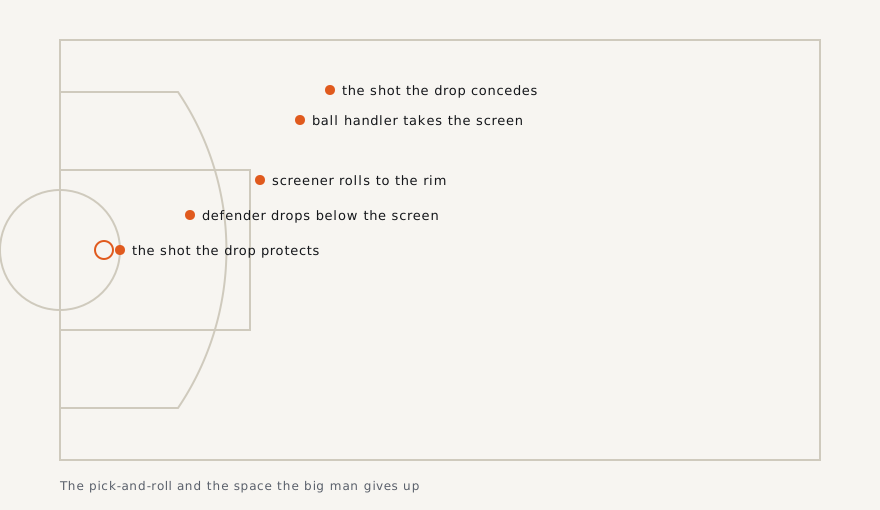
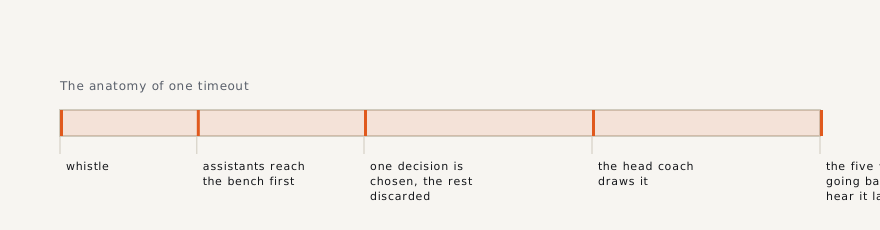
Two players screen, two players defend, and the whole possession turns on how far back one of them stands. This is the choice being made.
Two offensive players meet near the top of the arc. One screens for the other. Two defenders have to decide, in about a second, how to share the responsibility, and the entire possession turns on how far back one of them stands. The most common answer in modern basketball is called drop, and it is the clearest example in the sport of a defence choosing which shot it is willing to lose to.
The problem the coverage is solving
A screen creates a moment where one defender is physically unable to follow his man. For that moment the offence has two players and the defence has, functionally, one and a half. Every coverage is a plan for who takes what during that moment and how the defence gets back to even afterwards.
There are only a few things the screener's defender can do. He can come out and meet the ball handler aggressively, trapping or at least containing him high. He can step up level with the screen and try to hold the ball handler in front. Or he can retreat toward the rim and concede the space in front of him.
That retreat is drop. The defender guarding the screener drops below the level of the screen toward the basket, taking responsibility for the roll to the rim, while the ball handler's defender fights over the top of the screen and tries to catch up.
What it gives away and what it protects
Drop concedes the pull-up jump shot. The ball handler comes off the screen, sees a defender sitting back, and has an unobstructed look from somewhere between the arc and the free-throw line. That shot is the price of the coverage and it is paid every single time.
What it buys is the rim. The screener rolling toward the basket has a body between him and the hoop. The lob is contested. The drive is walled. The two highest-value outcomes in basketball — a shot at the rim and a foul drawn at the rim — are the ones drop is designed to prevent, and it prevents them reliably.
So the coverage is a trade, and it is a defensible one. A team that forces an opponent into pull-up jumpers instead of layups and free throws has improved its evening, provided the opponent cannot make the pull-up jumpers.
Why big men quietly hate it
Three reasons, and only one of them is about basketball.
The first is that drop asks a defender to be visibly beaten over and over. He stands back, a shot goes up over him, and to anybody not watching the whole possession it looks like he did not contest. Doing the assignment correctly and being blamed for the outcome is a bad combination, and it shows up in how players talk about the coverage.
The second is that drop puts him in two places at once by design. He is responsible for a roller behind him and a shooter in front of him, and the offence gets to decide which. A ball handler who can shoot and pass with equal threat makes the assignment unwinnable on any single possession; the coverage only works in aggregate.
The third is physical. Dropping means covering ground backwards and then recovering forward, repeatedly, for an entire game, and then doing it again two nights later. Coverages that look conservative on a whiteboard are frequently the most tiring ones to execute.
When teams abandon it
The coverage has an obvious counter: a ball handler who makes the shot it concedes. Against a player who can reliably punish a pull-up from that range, drop stops being a trade and becomes a donation, and defences switch to something else — stepping up to the level of the screen, switching the matchup outright, or sending a second defender at the ball.
Each of those has its own bill. Stepping up opens the roll. Switching puts a big man on a quick guard and a guard on a big man, which the offence will immediately attack. Sending help leaves somebody open on the weak side, and good offences are built to find that person in two passes.
This is the useful frame for watching any pick-and-roll: the defence is not trying to stop the play. It has already decided which part of the play it is giving up, and the only question is whether the offence takes what is on offer or insists on something else.
What to watch for
Find the screener's defender and look at his feet relative to the screen. Below it, retreating: drop. Level with it: a step-up. Above it, toward the ball: aggressive. Then watch where the shot comes from. If a team is getting pull-up jumpers all night, the defence is not failing — it is paying its bill and waiting to see whether the price was right.