How a highlight package gets cut before the game is over
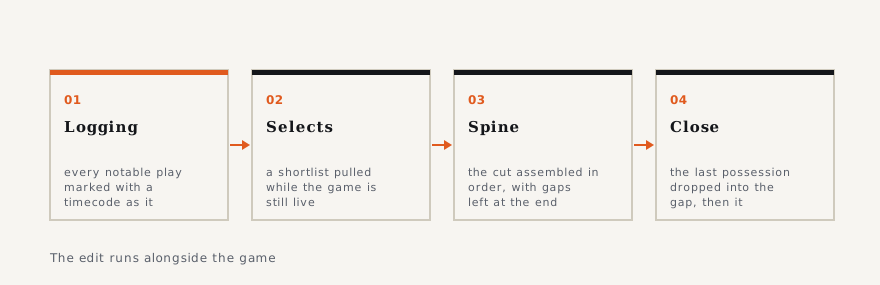
The two-minute edit that appears moments after the final buzzer was mostly finished in the third quarter. Here is the assembly line.
The final buzzer sounds and within a couple of minutes a two-minute edit is online: the night's plays, in order, cut to music or to commentary, with graphics at the front and the back. The speed looks impossible if you imagine someone sitting down to edit at the end of the game. Nobody does. The package was substantially finished in the third quarter, and the assembly line that makes that possible is worth describing because almost none of it is visible.
Logging: the part that happens during the game
From the first possession, somebody is marking the game as it goes. Every notable play gets a timecode and a short tag: dunk, block, three, turnover, injury, call. Which plays count as notable is a judgement made in real time by a person who cannot see the future, and that is the first place the final edit is shaped — a play nobody logged is a play that will not be found later, because nobody is going to re-watch a game to look for it.
Logging is usually not one person. A network covering a full slate of games has loggers working in parallel, often remotely, tagging to a shared system. The tags matter as much as the timecodes: a well-tagged game can be queried later for every block by a particular player across a season, and a badly tagged one cannot be queried at all.
Selects: the shortlist, built live
Somewhere around the second quarter, an editor starts pulling from the log into a shortlist. This is not the final cut; it is a pile of candidates, trimmed to rough length, usually with a few frames of handle on each end so they can be tightened later.
The shortlist is already longer than the finished package will be, and it is built with a shape in mind. Highlight edits have a conventional structure — an opening that establishes the game, a middle that escalates, a closing play that resolves it — and selects are chosen to populate those slots rather than purely on merit. A spectacular play in the first quarter will often lose its place to a merely good play in the fourth, because the fourth-quarter slot needs filling and the first-quarter slot is taken.
The spine: assembled with a hole in it
By late in the third quarter an editor is building the actual sequence: clips in order, transitions set, graphics templated, audio bed laid in. The end is deliberately left open — a gap sized for whatever the game's final possession turns out to be.
This is the trick that makes the publishing speed possible. Everything expensive is done before the game ends. What remains after the buzzer is dropping one or two clips into a prepared hole, replacing a score graphic, and exporting.
It also explains a quirk viewers notice and misread: when a game ends on something undramatic, the package can feel oddly weighted, with a flat closing play after a strong middle. The structure was built expecting a climax and the game did not supply one.
What gets cut, and why
Three forces trim the list, and only one of them is quality.
Length is the first. A package has a slot — a fixed duration for a broadcast segment, or a platform's preferred length for a social cut — and it will be filled to that duration whether the game produced that much material or not. A dull game yields a package of the same length as a great one, assembled from weaker plays.
Rights are the second. What can appear, for how long, and on which platform is contractual, and the terms differ between the broadcaster, the league and the clubs. The same play may be usable in a broadcast segment and not in a social clip, or usable in one territory and not another. Editors work from a set of rules they did not write.
Clearance is the third: music, sponsor visibility, anything involving an injury, anything involving a fan. An injury sequence is routinely cut even when it was the decisive moment of the game, and the package will be shaped around its absence.
Why the same play appears everywhere
Because the log is shared and the structure is conventional, independent editors working from the same game tend to converge on the same handful of plays. It is not copying. It is the predictable result of several people applying similar slot structures to the same shortlist.
The interesting consequence is what disappears. A game's best possession, judged as basketball — a long sequence of passing with no single spectacular moment — almost never survives the cut, because it cannot be reduced to a clip that works without context. The highlight package is a faithful record of a particular kind of moment and a systematic misrepresentation of the rest of the game, and it is built that way on purpose.