How a regional blackout works, and who it is actually protecting
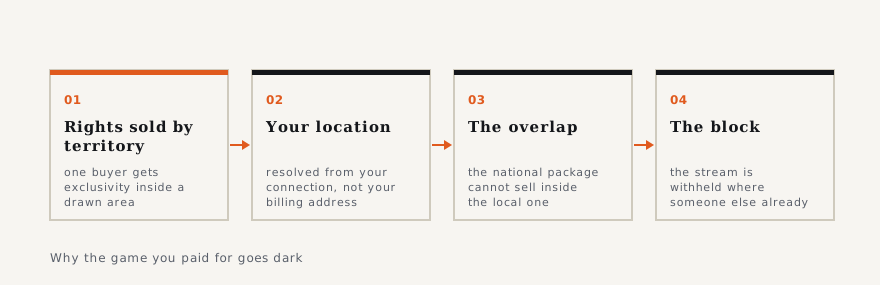
A blackout is not a punishment and it is rarely about the arena being empty. It is a map problem, and the map was drawn before streaming existed.
You pay for a package that advertises every game. A game starts. The app tells you this one is not available in your area. The explanation offered is usually a sentence about broadcast restrictions, which explains nothing. The actual mechanism is a map, a contract, and a guess about where you are, and understanding it makes the behaviour predictable even if it does not make it less irritating.
Rights are sold by territory, not by audience
Start with the thing being sold. A league does not sell "the right to show games". It sells bundles of rights, and those bundles are cut along several axes at once: which games, which platforms, which languages, and — the one that matters here — which geographic areas.
A local broadcaster buys exclusivity inside a defined area. Exclusive means exclusive: the point of the payment is that nobody else may show that game to those people. A national package, sold separately, covers the rest of the country, and it is sold with a hole in it exactly the shape of every local deal.
A blackout is that hole becoming visible. The national service is not withholding the game to punish anybody or to push you toward a ticket. It is withholding the game because it does not have the right to show it to you — somebody else bought that right, and the national seller could not have sold what it did not own.
The territory is a drawn line, and it was drawn a long time ago
The areas are not natural. They are negotiated boundaries, historically built around where a television signal reached and where a club claimed a following. Some are a metro area. Some are several states. Some overlap, so a single location can sit inside two clubs' territories and be blacked out for both.
Two consequences follow, and they are the source of most of the absurd cases. A viewer can be hundreds of miles from a club and inside its territory, blacked out from a team they have no connection to. And a viewer inside a territory who cannot receive the local broadcaster at all — no cable, no antenna reach — is blacked out from the national service without having any way to watch the game legitimately. That second case is not an edge case; it is the structural complaint about the whole arrangement, and it exists because the map predates the distribution method you are using.
How the service decides where you are
This is where it gets practical. A streaming service has to place you inside or outside a polygon, and it does that with whatever signals it has.
The primary one is your connection: the address your traffic appears to come from, resolved through a geolocation database to a city or region. That resolution is approximate and occasionally wrong, which is why people near a boundary report inconsistent behaviour from one night to the next — nothing changed except which record the database returned.
Secondary signals get used too: the address on the account, device location where the app can ask for it, and sometimes the mobile network. Services differ in which they trust, and a service that trusts your connection will behave differently when you travel than one that trusts your billing address. A viewer on holiday may find a home-market game suddenly available and an away game suddenly gone.
Why "the arena is empty" is the wrong explanation
The oldest justification for blackouts was protecting ticket sales: do not show the game locally and more people will come. That rationale has largely been abandoned in practice, and it never explained the structure anyway — it would predict blackouts near the arena, not across several states, and it would not predict blackouts of away games.
The structure is explained entirely by exclusivity. The question to ask about any blackout is not "who is being punished" but "who already owns the right to show this to me", and the answer is almost always a local broadcaster you may or may not be able to receive.
What actually changes it
Only one thing: the rights being sold differently. When a league buys back local rights, or sells a direct national package without territorial carve-outs, the blackout disappears for those games — not because anyone fixed the technology but because the hole in the national package closed. That has happened in some sports and some markets and not others, which is why the experience is wildly inconsistent between leagues and between countries.
Everything else — the apology screen, the location check, the help page — is machinery built to enforce a boundary somebody negotiated, in some cases decades before the service you are using existed.