Why the score bug moved to the bottom of the screen
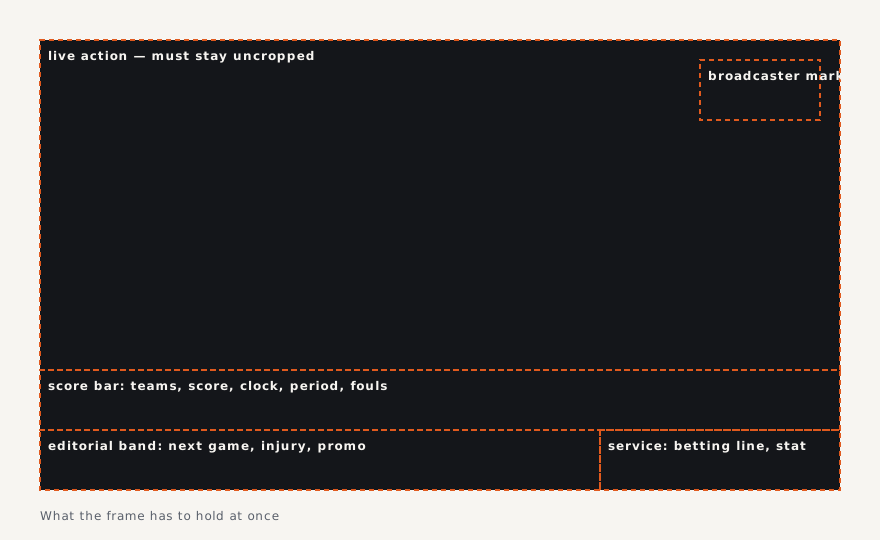
For years the score sat in a corner. Then it became a bar across the bottom. The reason is not taste; it is what else now has to fit.
For most of the history of televised basketball, the score sat in a corner of the frame: a small box, two abbreviations, two numbers, a clock. Now it is a bar across the bottom. The change happened gradually enough that most viewers never registered it as a change, and the reasons for it are almost entirely about things other than the score.
What a corner box could hold
A corner graphic is constrained by shape. It is roughly square, it has to stay small enough not to obscure action, and it can hold about four pieces of information before it becomes unreadable: two teams, two scores, and a clock crammed underneath.
That was adequate while four pieces of information were all a broadcast had to display. It stopped being adequate when the list grew, and the list grew for reasons that had nothing to do with basketball.
What the frame now has to carry
A modern basketball broadcast is expected to display, more or less continuously: both teams, both scores, the game clock, the period, the shot clock, team fouls, timeouts remaining, and in many productions possession. That is eight or nine fields, and they do not fit in a square.
They fit in a strip. A horizontal bar can hold a row of fields at a readable size, and critically it can hold them in a stable order, so a viewer learns where to look once rather than hunting. That stability is worth more than the screen area it costs, which is the core of the design argument.
Then there is everything that is not the game. A bottom band is also where a broadcast puts scores from other games, upcoming schedule, injury notes, sponsor messages and — on many modern productions — a betting line. None of those can live in a corner box, and all of them now expect a place in the frame. Once a broadcast has decided it needs a persistent bottom band for that material, putting the score at one end of the same band is nearly free.
The constraint nobody mentions: where the action is
A basketball frame is not uniformly important. The main game camera sits high at centre court and frames the half of the floor in play, which means the top of the frame is usually the far sideline and the stands behind it, and the bottom of the frame is usually the near sideline and the floor.
That makes the top edge cheap in one sense — it is often crowd — but expensive in another: a lob, a high ball-screen read and any shot in flight travel upward through the frame. The bottom edge contains floor, the near sideline and, on many shots, nothing of consequence. Overlaying the bottom costs less live information than overlaying the top. Corners were chosen originally because they were the smallest intrusion available for a box; a strip at the bottom is the smallest intrusion available for a row.
Phones changed the arithmetic again
A graphic designed for a large screen at a normal viewing distance can be subtle. The same graphic on a phone held at arm's length has to be larger relative to the frame, which pushes toward fewer, bigger fields.
That is in direct tension with the growth of the field list, and the resolution has been to make the bar layered rather than larger: a core group of fields always present, and a secondary group that cycles — fouls, then timeouts, then the other scores. Anything that cycles is a field somebody decided was not important enough to be permanent, which makes the cycling slots a readable record of a production's priorities.
Why it will probably keep moving
Two pressures point in opposite directions. Everything added to a broadcast — a new statistic, a new commercial surface, a new service — wants persistent space, and the bottom band is where persistent space lives. Meanwhile the most-watched surface keeps getting smaller, which argues for less of it.
The likely outcome is not a return to the corner but a further split: a minimal permanent strip, with everything else moved into transient overlays that appear and leave. Some productions already work that way. If you want to know what a broadcaster thinks is essential, do not read its graphics package — watch which fields never disappear.