What a courtside microphone actually picks up
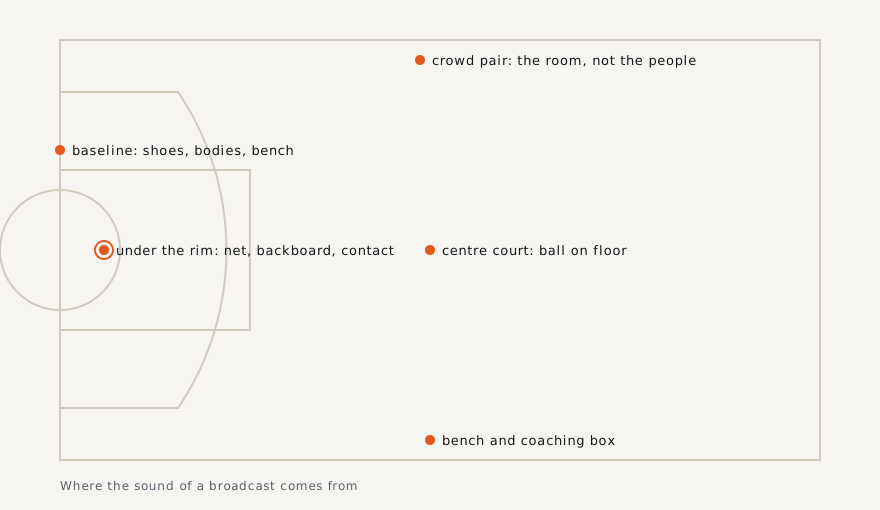
The sound of a basketball game on television is built, not captured. Most of what you hear comes from microphones nobody points at the players.
The sound of a televised basketball game — the squeak, the snap of the net, the thud of a body hitting the floor, the room-filling noise of a crowd — is not captured by pointing a microphone at the court. It is built from a dozen or more sources, mixed live by someone who is making continuous editorial decisions about what the game sounds like. Most of what you hear comes from microphones aimed at nobody in particular.
The sources, roughly in order of how much work they do
Under the backboard, on each basket, sit microphones that exist for three sounds: the ball through the net, the ball off the rim or glass, and contact at the rim. They are the closest thing to a star in the mix, because those three sounds are what makes a basketball broadcast sound like basketball rather than like a room with people in it.
Along the baselines and at floor level sit microphones for the floor itself: shoes, bodies, the ball on hardwood. This is where the squeak lives. It is also the most heavily managed part of the mix, because floor microphones sit a few feet from benches and pick up speech that the broadcast has no intention of airing.
Above and around, aimed at the stands rather than the court, are crowd microphones, usually in pairs for stereo width. These are not there to record individual spectators; they are there to record the room — its size, its reverberation, the general rise and fall. A broadcast's sense of being in a big building comes almost entirely from these, and from how much of them the mixer pushes up.
Then there are the microphones attached to people: commentary positions, the sideline reporter, sometimes an official with a wireless pack for announcing calls. These are the only microphones in the building pointed at a specific mouth, and they are mixed as speech rather than as atmosphere.
What the mixer is deciding, continuously
Three balances, all moving.
The first is court against crowd. Push the court up and the game sounds intimate and technical; push the crowd up and it sounds like an event. The right answer changes within a single possession — a free throw wants court, a run wants crowd — and the person riding those faders is making that call several times a minute.
The second is speech against everything. Commentary has to sit above the bed without sounding like it is in a different building. When a commentator stops talking, the bed has to come up or the broadcast goes oddly quiet, and that lift is manual.
The third, and the one with the most consequences, is what to take out.
The sound that is deliberately not there
Floor microphones a few feet from a bench pick up coaching instructions, player conversation, and language that a broadcast will not air. They also pick up officials talking to each other and to coaches, which is information the broadcast may or may not be permitted to use.
Handling that is a standing part of the job rather than an emergency measure. Specific microphones are ducked during timeouts and dead balls. Some are gated so they only open above a certain level. In live broadcasts there is a delay of a few seconds precisely so that something audible and unairable can be removed before it reaches the audience, which is why a broadcast's "live" is always slightly behind the building.
The result is a strange asymmetry: the microphones closest to the most interesting speech in the arena are the ones most aggressively suppressed, and the audience hears the floor mainly as texture.
Why the game sounds different on different broadcasts
Same arena, same game, two feeds, two distinctly different sounds. The microphone positions are largely standardised; the mix is not. One broadcaster's house style may favour the court and the technical detail; another's may favour the room. A national feed and a local feed of the same game will differ, and a feed produced for a highlights platform differs again, because a clip that will be watched on a phone needs a mix with more midrange and less room.
What this means for what you think you heard
Two practical things. The clarity of a specific sound — a snap of the net, a particular squeak — is evidence about the mix, not about how loud it was in the building. And the absence of a sound is frequently a decision rather than a failure. On a broadcast, silence in a particular part of the frequency range at a particular moment is one of the more reliable signs that somebody removed something.