Why a broadcast shows you the same replay three times
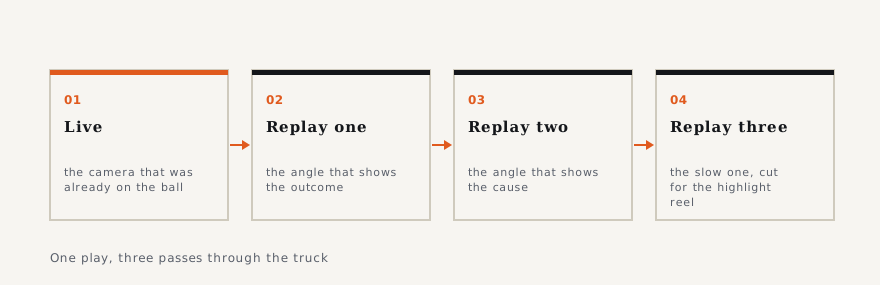
It looks like indecision. It is a production rule, and once you know the rule you can predict the third angle before it arrives.
A play happens. The broadcast shows it again from behind the basket, then again from the opposite baseline, then a third time in slow motion, and by then the next possession is already underway and the commentary has to catch up. It reads as indecision — as though the director could not settle on an angle. It is the opposite. There is a rule, it is close to universal, and once you know it you can call the third angle before it arrives.
The rule
Each replay has a different job. The first one shows the outcome, because that is what the audience wants confirmed: the ball went in, the foul was there, the foot was on the line. The second shows the cause, which is almost always somewhere other than where the outcome happened — the screen two seconds earlier, the defender who rotated late, the pass that preceded the pass. The third, if there is time, shows the craft: slowed down, tight, usable later as a standalone clip.
So the sequence is not three attempts at one thing. It is three different statements, and they are ordered by how quickly the audience needs them. If the play was simple, the second and third are skipped. If the play was contentious, the second expands and the third never comes, because the broadcast has moved to officiating.
Why it has to be fast, and what that costs
A replay has to land before live action resumes, which in basketball means a window of a few seconds after a made basket and often no window at all after a miss. That constraint shapes everything.
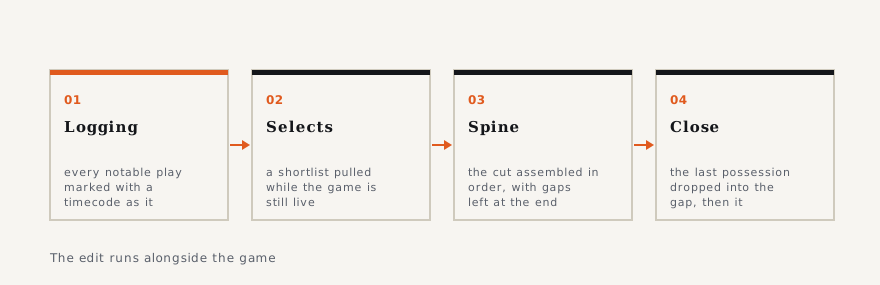
The operators who cut replays are not watching for the best angle; they are each assigned a camera and they are marking in-points continuously, so that when the director calls for a look, the clip already exists. Nobody searches during a live game. The library is built as the game goes.
The cost of that speed is that the angle you get is the angle somebody had already marked. A play whose cause happened off-ball, away from where the cameras were pointed, may have no second replay available at all — not because the director did not want it but because no operator was marking it. This is the real reason some obvious questions go unanswered on a broadcast: the shot does not exist.
What the angles are actually for
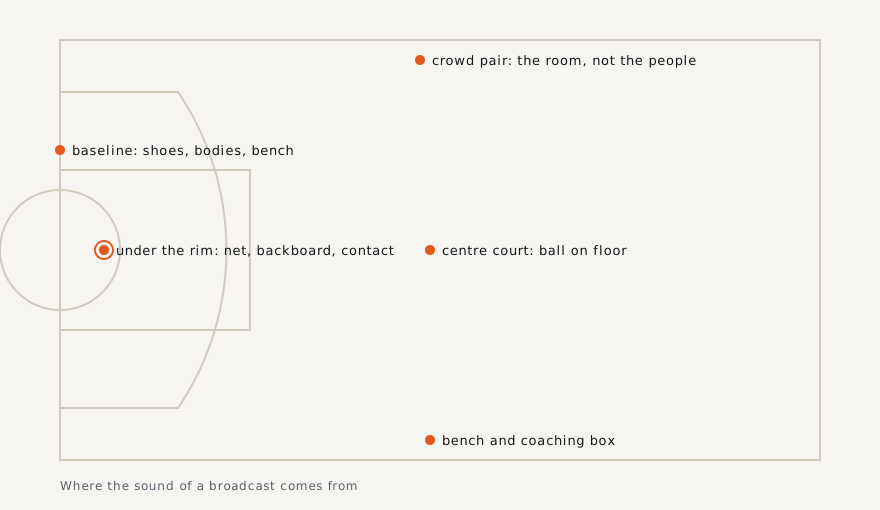
The main game camera, high and at centre court, is the only one that reliably shows spacing — where all ten players were. It is the least dramatic angle and the most informative, and it is almost never used for a replay, because replays are chosen for clarity of a single action rather than for context.
The baseline cameras show contact and the rim. They are the outcome cameras, and they are also the ones that distort distance most, which is why a shot that looked long from the baseline turns out to have been from well inside the arc.
The opposite-side camera exists so that a play obscured by bodies from one side can be seen from the other. It is the workhorse of the second replay.
The tight, long-lens cameras are not for understanding anything. They are for faces, hands and the slow third look.
When the pattern breaks, it is telling you something
Three useful tells.
If the broadcast goes to the same angle twice, the first one probably did not show what the director expected, and the second is a correction rather than a new statement.
If a replay is held on screen while live play continues in a small window, the production has decided the replay matters more than the live ball — which in practice means an injury, an ejection or a call under review.
And if a clear incident gets no replay at all, that is a decision, not an oversight. Broadcasts regularly decline to replay things they would rather not adjudicate: a thrown elbow away from the ball, a fan incident, a coach's language. The absence is editorial.
Why it feels repetitive when it is not
The audience experiences three replays as one event viewed three times, because the thing being explained is the same play. The production experiences it as three answers to three questions. Both readings are internally consistent, which is why the complaint never goes away and why the practice never changes.
The practical consequence for a viewer: watch the second replay rather than the first. The first one tells you what you already saw. The second one is where the production is telling you what actually happened.