“Clutch” is the hardest word in basketball argument
Everybody uses it, nobody defines it the same way twice, and the definition is where the entire disagreement actually lives.
No word in basketball argument does more work with less agreement than clutch. It is used as praise, as insult, as explanation and as prediction, often by two people in the same conversation who are using it to mean different things and who both believe they are disagreeing about a player. They are not. They are disagreeing about a definition, and almost none of the argument survives once the definition is fixed.
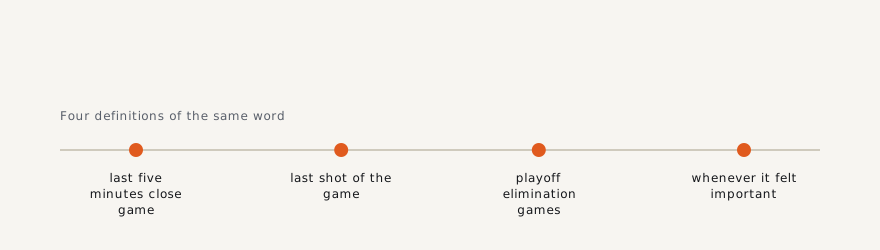
Four definitions, all in common use
The first is situational and bounded: the last few minutes of a game within a small margin. This is the definition most statistical sources use, because it can be applied mechanically. It has the virtue of being checkable and the drawback of being arbitrary at the edges — a game decided by a shot with four minutes left does not qualify, and nothing about the shot was different.
The second is narrower and more popular in conversation: the final possession. The last shot, the one that wins or loses it. This definition produces tiny samples — a player may face a handful of such moments in a season — and it is the definition most responsible for confident claims built on almost no evidence.
The third is structural: elimination games, closeout games, the moments where a series ends. This is a definition about stakes rather than about score and clock, and it is the one most often used by people arguing about careers rather than about seasons.
The fourth is the honest one, and it is the most common: clutch means the moments that felt important. It is retrospective, it is unfalsifiable, and it is how the word is used most of the time.
Why the argument is usually about the definition
Pick a player who has produced well in bounded late-game minutes and poorly on final possessions. Under the first definition he is clutch. Under the second he is not. Both statements are true. Two people can therefore argue indefinitely, each with accurate evidence, and never discover that they are measuring different things.
This is not a pedantic point; it is the whole structure of the dispute. The productive move in any clutch argument is to ask which window the other person is using before responding to anything else, and the striking thing is how often neither party has decided.
The sample problem, stated carefully
Whichever definition is chosen, the moments it picks out are rare. That has two consequences that pull in opposite directions and both get ignored.
The first: small samples produce extreme results. A player who takes a handful of final shots in a season will post either a very good or a very bad conversion rate almost regardless of his ability, because with that few attempts there is no middle. Extreme clutch numbers are what small samples look like, not what special ability looks like.
The second, less often said: this does not prove the ability does not exist. A thing can be real and still be unmeasurable at the available sample size. The honest position on whether some players are reliably better in high-pressure moments is that the available evidence cannot settle it, which is an unsatisfying thing to say in an argument and is nonetheless where the evidence is.
What is genuinely measurable
Some adjacent things are measurable and get confused with clutch. Whether a player's usage rises late — whether he takes a larger share of his team's shots in those minutes — is straightforwardly countable, and it is a fact about how he is used rather than about how well he performs. Whether his shot difficulty rises late is measurable too, and it almost always does, because defences change in those minutes. A player whose conversion rate falls late while his shot difficulty rises sharply may be performing better than the rate suggests.
Separating those two — more shots, harder shots — from the thing people mean by clutch is most of what a careful version of this argument involves.
A better question to ask instead
Replace "is he clutch" with two questions that have answers. Does his team get a good shot in those minutes, and is he the reason? Does his usage go up, and should it? Both are about the offence rather than about the player's character, both are checkable, and between them they cover almost everything anyone actually wanted to know when they reached for the word.