The load-management argument, without the outrage
Two sides are answering two different questions and treating each other as liars. Separate the questions and the argument gets smaller and better.
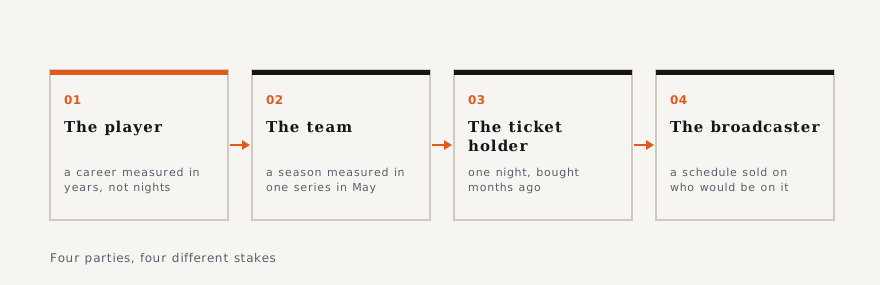
Few arguments in sport generate as much heat with as little engagement as the one about resting healthy players. Each side treats the other as acting in bad faith. In fact there are four parties with four different and mostly legitimate interests, and the argument is unresolvable in the terms it is usually conducted because it is not one disagreement. It is four.
The player's question
A playing career is measured in years. The specific risk is not mysterious: a large share of the injuries that end or diminish careers are soft-tissue and overuse injuries, and the mechanism — accumulated load without adequate recovery — is the best-understood thing in sports medicine. Reducing load reduces that risk.
From the player's position the calculation is straightforward and not selfish: a night off in January is cheap, a tendon is not. The reason this argument became prominent when it did is that teams got substantially better at measuring load, so the thing that was previously a hunch became a number somebody was accountable for.
The team's question
A team's season is not measured in nights. For a serious contender it is measured in one series in spring, and almost every regular-season decision is an input to that. A team that believes it has a title chance will trade an ordinary January game for a healthier roster in May without hesitation, and it would be mismanagement not to.
The complication is that this logic is only available to some teams. A club fighting for a playoff place cannot spend games. A club with no chance at all has a different incentive again. So the same policy is rational for one team and irrational for another, which is why the practice is unevenly distributed and looks arbitrary from outside.
The ticket holder's question
This is the interest most often dismissed and the one with the strongest claim. A ticket is bought in advance, frequently months in advance, at a price influenced by who was expected to play, and sometimes for a once-a-season visit by a particular team. The person who bought it has no mechanism for recourse and no information in advance.
Note what the complaint actually is. It is not usually that the player should play through injury risk. It is that the transaction was asymmetric: one side knew the plan and the other paid for a different expectation. That is a fairness claim about disclosure and pricing, and it is not answered by medical arguments, which is why medical arguments never satisfy it.
The broadcaster's question
A national broadcast schedule is built in advance around matchups and players. The value of a particular night was estimated assuming particular people would be on the floor. When they are not, the broadcaster has paid for something it did not receive and cannot reprice.
This is the interest with the most leverage and the least public sympathy, and it is the one that has driven most of the actual rule-making. Policies that restrict resting in nationally televised games, or that require players to be available for a minimum number of games, exist because this party can negotiate, and the ticket holder cannot.
Where the argument actually is
Once separated, most of the heat turns out to be in two places.
The first is whether the medical case is as strong as it is presented. Load management is well founded in principle; the specific claim that a particular healthy player should miss a particular game is much less certain, and teams present the general finding as though it settled the specific case. That is a fair criticism and it is rarely made precisely.
The second is disclosure. Almost every version of the ticket holder's complaint is addressed by earlier and more honest notice, and almost none of it is addressed by debating recovery science. The leagues that have made progress on this did so through notice requirements rather than through persuasion.
What a useful version of this argument looks like
State which party's interest you are arguing for. Accept that the other three exist and are not frauds. Then argue about the two things that are genuinely open: how strong the evidence is for any individual decision, and what the person who paid is owed in advance. Everything else in this dispute is four groups of people answering different questions loudly.