What people mean when they call a player “system-proof”
It sounds like praise and it is usually a hedge. The phrase does real work in an argument — it moves the burden of proof.
A phrase has settled into basketball conversation that sounds like praise and functions as an argument: a player is described as system-proof. He would produce anywhere. Put him on any roster, in any scheme, with any coach, and the output travels. It is worth taking the phrase apart, because it does real work in a debate and most of that work is done quietly.
What the claim contains
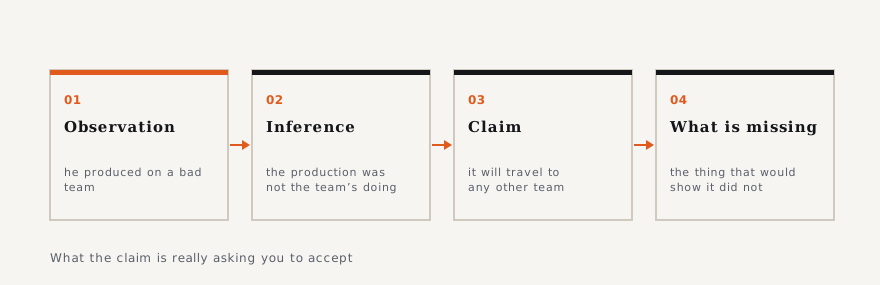
Unpacked, it is three statements stacked on each other, and only the first one is usually supported.
The observation: this player produced on a team that was not set up to help him. True, checkable, and often genuinely impressive.
The inference: the production was therefore his, not the team's. This is where the weight shifts, and it does not follow automatically. A bad team can be a favourable environment for an individual's statistics — more shots available, less competition for touches, defences that scheme for one player because there is nobody else. Production on a weak team is evidence about opportunity as much as about ability.
The prediction: the production will travel to any other context. This is the actual claim, it is about the future, and it is the part with no evidence behind it at all until the player changes context.
Why the phrase is persuasive
Because it reverses the burden of proof, and it does so without announcing that it has.
Normally the person claiming a player will produce in a new situation has to argue for it. System-proof makes the player's portability the default and puts the burden on anyone who doubts it. And the doubt is hard to discharge, because the only thing that could settle it — the player in a different system — has not happened yet.
It also has a built-in defence against the obvious counterexample. If a system-proof player moves and does not produce, the phrase survives: the new situation was uniquely bad, the fit was strange, the usage changed. The claim is constructed so that no single outcome refutes it.
What would actually be evidence
The honest version of this argument is possible, and it looks different. Things that genuinely bear on portability:
Production across more than one context. A player who has produced in two meaningfully different systems, with different coaches and different casts, has demonstrated something a player who has only produced in one has not. This is the single strongest available evidence.
Skills that are plausibly context-independent. Free-throw shooting, defensive rebounding and spot-up shooting travel more reliably than skills that depend on being the focus of an offence. A player whose value is concentrated in high-usage ball-handling is more context-dependent than one whose value is spread across skills that do not require the ball.
Shot profile. A scorer who manufactures most of his attempts himself is less dependent on teammates than one whose attempts arrive created, which cuts against the usual direction of this argument: the high-usage player may actually be the portable one, and the efficient pass-fed shooter the fragile one.
Role versus usage. A player whose production scales down smoothly as his share of the offence falls is portable. A player whose production is only available at a very high share is not system-proof; he is system-requiring, which is a different thing and not necessarily worse.
The term's useful cousin
There is a claim near this one that is much more defensible: a player can be scheme-independent on defence. Defensive value from size, hands and positional discipline transfers across coverages better than offensive value transfers across offences. If somebody uses system-proof to mean that, they are saying something supportable.
Where the evidence would have to come from
The honest version of the claim needs a player who has been through at least two offences that wanted different things from him, and whose production survived the move. That evidence exists for some players and simply does not exist for most, because most players spend their good years in one place, with one coach, inside one idea about how to score. A trade in mid-career, a coaching change, a long international summer under a staff with its own preferences: those are the natural experiments, and they are the only times anybody gets to watch the same player inside two different machines.
This is why the phrase shows up most often about young players, which is exactly backwards. A rookie has one sample, taken inside whatever his team happened to run. Everything said about how his game would travel is inference from the shape of his skills, not observation of them travelling. That inference can be good — the skill list above is a reasonable basis for it — but it should be stated as what it is, so that the next two seasons can confirm or refuse it instead of being read as having already confirmed it.
How to respond when you hear it
Ask which contexts the player has produced in, and how different they were. If the answer is one, the claim is a prediction dressed as an observation. That is not a reason to dismiss it — predictions are allowed — but it changes who has to argue for what, which was the point of the phrase in the first place. The follow-up question is just as cheap: name the part of his game that would have to be rebuilt somewhere else. If nobody can name one, the claim is not about the player at all; it is a compliment with a technical vocabulary.