Points per possession: what the number actually measures
Every modern basketball argument runs on one fraction, and almost nobody says out loud what goes in the denominator. Here is the whole of it.
Watch any broadcast long enough and a number will appear that is supposed to settle an argument: this offence scores so much per possession, that one scores less. It is the unit that modern basketball analysis is denominated in. It is also a number most people quote without ever having been told what a possession is, which is a strange way to run an argument, because the whole weight of the fraction sits in the denominator.
The numerator is the easy half
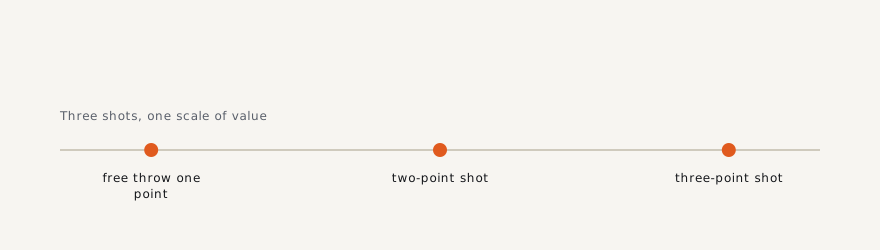
Points are points. A free throw is one, a shot inside the arc is two, a shot with both feet behind it is three. There is no judgement in the top of the fraction and no version of it that anyone disputes. Every disagreement about offensive efficiency is a disagreement about what you divided by.
A possession is not a trip, and it is not a shot
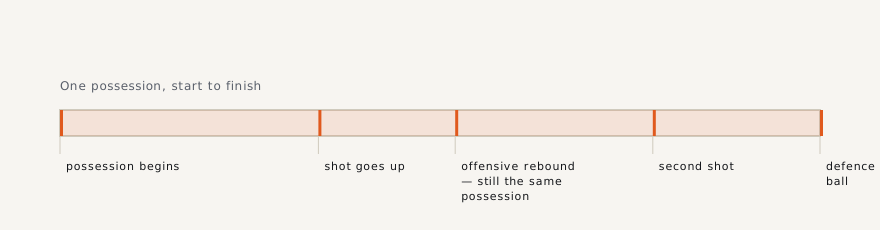
A possession begins when a team gains control of the ball and ends when the other team gains control of it. That is the entire definition, and almost every intuition people carry about it is wrong in the same direction: they count too many.
If a team shoots, misses, rebounds its own miss and shoots again, that is one possession with two shots in it. If it misses that one too, rebounds again and scores, that is still one possession. The shot clock resets; the possession does not. This is why a team that rebounds its own misses well can look like a bad shooting team and a good offence at the same time, and why those two statements are not in conflict.
The same logic runs the other way. A turnover on the inbound pass, with no shot attempted at all, is a complete possession worth zero points. An offence that gives away a handful of those per game is spending possessions without ever appearing in a shooting statistic, which is precisely why turnovers hurt more than they look like they should.
Why the number has to be estimated
Here is the part that gets left out. For most of basketball history nobody recorded possessions directly, so the figure in general use is not counted — it is reconstructed from the things that were recorded. The reconstruction works from the four ways a possession can end: a made shot, a missed shot the defence rebounds, a turnover, or a trip to the line that finishes with a free throw.
That means the standard possession count is an estimate built on a box score, and estimates built on box scores inherit the box score's blind spots. An offensive rebound has to be subtracted, because it continued a possession rather than starting one. Free throws have to be converted into some fraction of a possession, because two free throws are usually one trip and sometimes are not. Team rebounds, jump balls after a held ball, and the end of a quarter all have to be handled by convention rather than by observation. Different publishers use slightly different conventions, which is the dull and real reason two sites can print two different efficiency figures for the same game without either of them being wrong.
What per-possession actually buys you
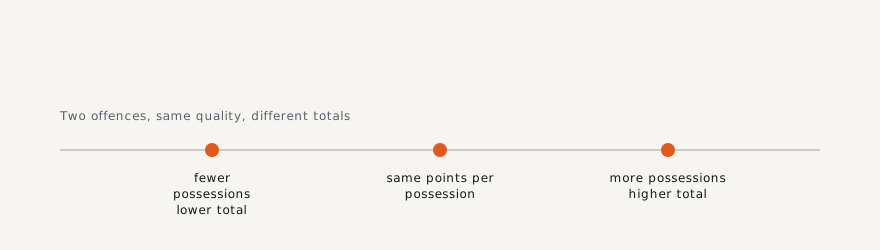
It buys comparability between teams that play at different speeds. A team that plays fast will score more points than a team that plays slowly even if every single one of its possessions is worse, because it has more of them. Dividing by possessions removes speed from the comparison entirely. That is the whole purpose, and it is a good one: pace is a choice, quality is not.
It also buys a cleaner way to talk about defence. Points allowed per game rewards a defence for playing slowly, which is not a defensive skill. Points allowed per possession does not.
What it does not buy
It does not tell you why. An offence can post the same figure by taking excellent shots badly or mediocre shots well, and the number is blind to the difference. It does not survive small samples, because the denominator in a single quarter is small enough that one broken play moves the fraction visibly. And it carries no information about the opponent: an efficiency figure compiled against tired defences in the second night of back-to-backs is not the same measurement as the same figure compiled against rested ones, even though it prints identically.
The useful habit, when the number appears on screen, is to ask the two questions it cannot answer by itself: over how many possessions, and against whom. Most of the time nobody has said.
How to read it in one sentence
Points per possession is a statement about the quality of the trips an offence takes, with the number of trips deliberately removed — a reconstruction rather than a count, which is accurate enough over a season and much shakier over a quarter than its decimal places suggest.