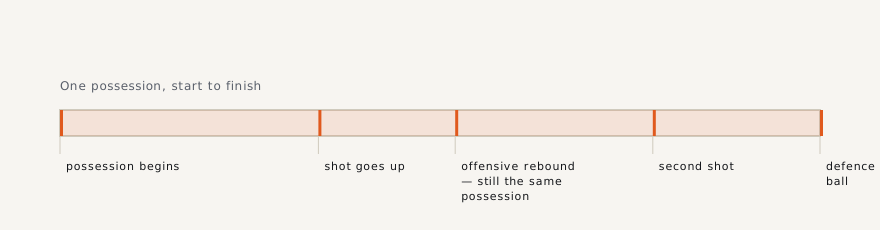
Pace, possessions, and why a team’s totals lie to you
A team that scores more points than another team may be the worse offence. The reason is arithmetic, not opinion.
A team averages more points per game than another team. The straightforward reading is that it has the better offence. The straightforward reading is unreliable, and the reason is not statistical sophistication — it is division.
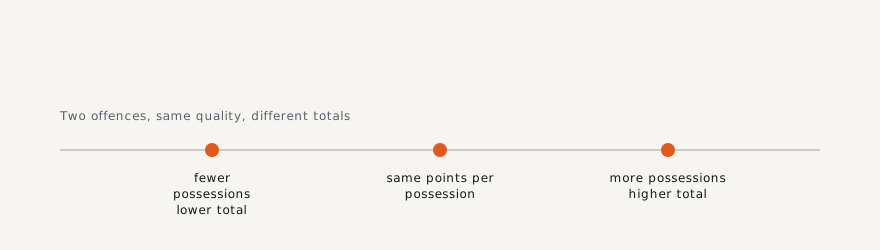
Two offences, same quality, different totals
Consider two teams that produce exactly the same value from each trip down the floor. One of them plays quickly: it shoots early, it pushes after a miss, it inbounds and goes. The other plays slowly: it runs a possession deep into the shot clock, it walks the ball up, it rebounds patiently. At the end of the night the fast team has more points, the slow team has fewer, and the quality of their offences is identical.
Points per game is a product of two things — how good your possessions are and how many you take — and it does not distinguish between them. A team can raise its scoring average without improving at all, simply by playing faster. It can also raise its points allowed without its defence getting worse, by the same mechanism, because a faster game gives the other team more trips too.
Pace is a choice, not a skill
This is the part worth sitting with. Speed is a strategic decision, and it is close to symmetric: a team that plays fast gets more possessions and so does its opponent. There is no free scoring in pace. The reasons to play fast are real but they are not "more points" — they are that early offence tends to face a less organised defence, that a young team may be fitter than its opponents, that a weaker team may prefer a higher-variance game.
And the reasons to play slowly are equally real: fewer possessions means fewer chances for the better team to assert itself, which is why underdogs in single-elimination formats have reached for the slow game for as long as the format has existed.
Because pace is a choice on both sides, leaguewide scoring averages move for reasons that have nothing to do with how well anyone is shooting. A rule change that shortens the reset after an offensive rebound raises everybody's totals. A season in which teams collectively decide to shoot earlier raises everybody's totals. Reading those shifts as improvements in offensive quality is the single most common error in casual basketball statistics, and it recurs every few years.
What to divide by
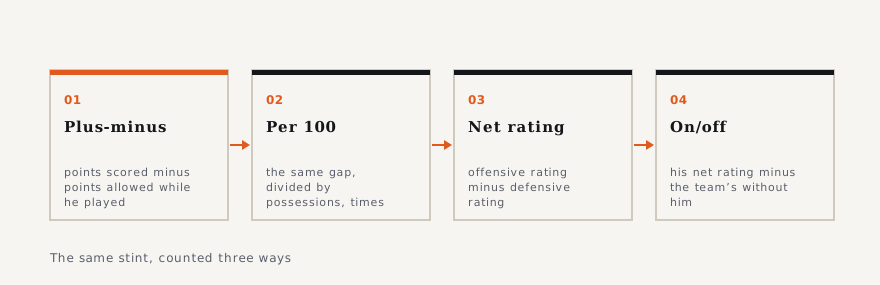
The fix is the same one that fixes everything else in this family: divide by possessions. Offensive rating — points per hundred possessions — asks how good the trips were and deliberately discards how many there were. Defensive rating does the same on the other end. Pace itself becomes a separate, reportable quantity: possessions per game, listed next to the ratings rather than hidden inside them.
Reported that way, a team's identity becomes legible in three numbers instead of being smeared across one. A slow, efficient team and a fast, mediocre one can post the same points per game and look nothing alike.
Where the lie bites hardest
Three places, reliably.
The first is comparing eras. Scoring averages from different decades are not comparable without a possession count, because the number of possessions in a game has changed substantially and repeatedly. A points-per-game comparison across a rule change is a comparison of two different games.
The second is individual scoring. A player's points per game inherits his team's pace and his own minutes. Points per possession, or points per shooting chance, says something about the player; points per game says something about the player, the coach's rotation and the team's preferred tempo, blended.
The third is defence, where the distortion is strongest and least noticed. A team that plays slowly will allow fewer points per game than an identical team that plays quickly, so points allowed per game rewards tempo and calls it defence. Every few seasons a team gets praised for a defence that is mostly a pace preference.
One sentence to carry away
A total is a rate multiplied by an opportunity count, and basketball lets teams choose their opportunity count — so any argument built on totals is partly an argument about tempo, whether or not the person making it knows that.