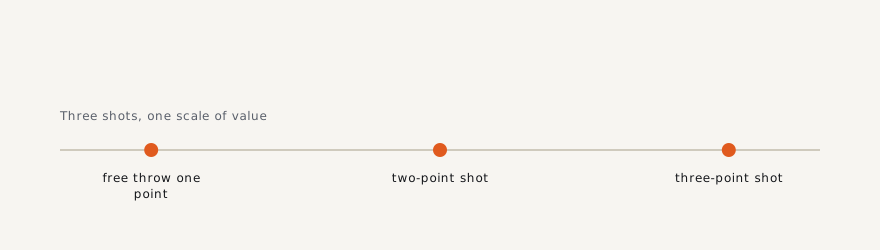
True shooting puts a three, a two and a free throw on one scale
Field-goal percentage treats a layup and a corner three as the same event. True shooting is the fix, and it is simpler than its name suggests.
Field-goal percentage is the oldest number in basketball and one of the least useful ones still in daily circulation. Its problem is simple enough to state in a sentence: it treats a layup and a shot from the corner as the same event, and it pretends free throws never happened. True shooting is the repair. It gets described as an advanced statistic, which is unfortunate, because the idea underneath it is a piece of arithmetic that would not trouble anybody.
The problem, concretely
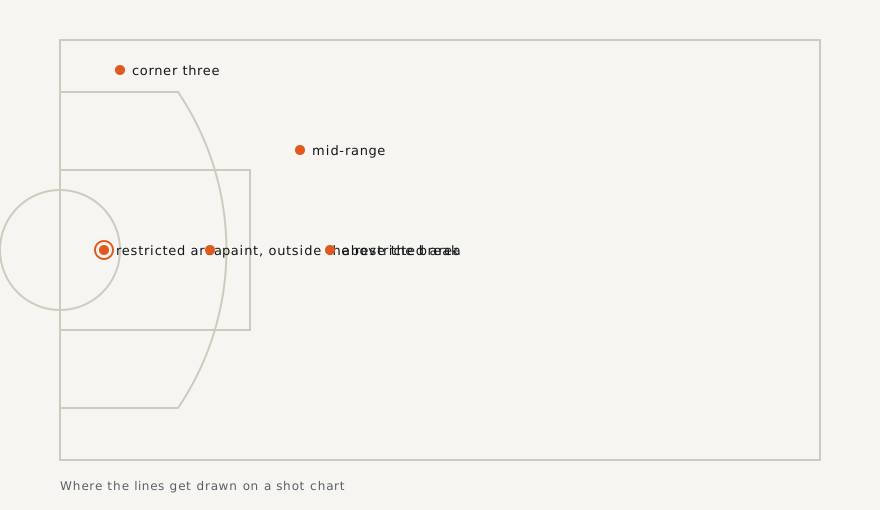
Two players take ten shots. The first takes ten shots inside the arc and makes five: ten points, fifty per cent. The second takes ten from behind it and makes four: twelve points, forty per cent. By field-goal percentage the first player shot better. By the only measure that moves a scoreboard, the second player produced more. Field-goal percentage answers the question "how often did the ball go in" when the question anyone actually cares about is "how much did these attempts produce".
Then there is the line. A player who draws a foul on a drive, goes to the line and makes both has produced two points and, in most scoring conventions, taken no field-goal attempt at all. His shooting percentage is untouched by a sequence that was, in every practical sense, a shot. A player whose game is built on contact can therefore be among the most productive scorers on a floor and look, in the oldest column, unremarkable.
What true shooting does
True shooting puts all three events on one scale by changing what it divides by. Instead of counting attempts, it counts scoring chances, and it expresses the result as points per chance, scaled so it reads like a percentage.
The numerator is total points — every point from every source. The denominator is field goal attempts plus a fraction of free-throw attempts, because free throws come in twos: two free throws represent roughly one trip to the line, so each one counts as roughly half a chance. That fraction is the only place where a convention enters, and it is the reason the formula has a stray decimal in it that looks arbitrary and is not.
The result has a property worth noticing: because the numerator is points rather than makes, a true-shooting figure can exceed the hundred per cent ceiling that field-goal percentage obeys. A player who makes every three he takes is producing three points per chance, which on this scale reads as one hundred and fifty per cent. That is not a bug. It is the scale telling you that the old percentage was never measuring value in the first place.
What it fixed
It fixed the comparison between a player whose shots are all close and a player whose shots are all far, which field-goal percentage could not do and effective field-goal percentage only half-did. It fixed the invisibility of foul-drawing, which is the single largest blind spot in the old number. And it gave the three-point era a way to describe itself, because the strategic shift of the last two decades is unreadable in field-goal percentage and obvious in this one.
What it still cannot see
It cannot see difficulty. A wide-open corner three and a contested fadeaway enter the denominator identically, so a player given easier shots will post a better figure for the same skill. This is the single most common misreading: a high true-shooting figure is partly a statement about the player and partly a statement about the offence that fed him.
It cannot see volume, either, and volume and efficiency trade against each other. The fifth option on a good team takes the shots nobody had to work for; the first option takes the ones left when a defence has spent the whole possession preventing everything else. Comparing their true-shooting figures without saying how many shots each took is a comparison of two different jobs.
And it says nothing about turnovers, passing, or whether the possession was worth starting. It is a shooting number. It is simply the shooting number that counts the points rather than the makes.
How to use it
Treat it as the first question rather than the last. If two scorers are being compared and only one of them lives at the line, true shooting is the number that makes the comparison honest. If the comparison is between a high-volume first option and a spot-up shooter, it is the number most likely to mislead. Both of those are properties of the scale, not of the players, and knowing which situation you are in is most of the skill of reading it.